

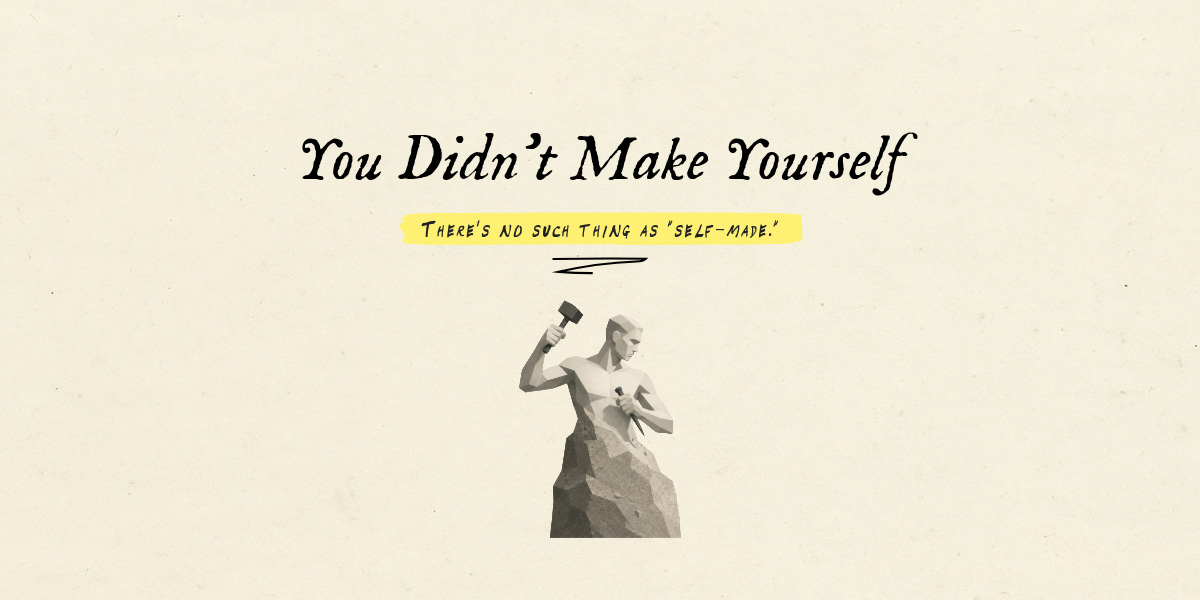
🪛 You Didn't Make Yourself
There's no such thing as "self-made."

Do you know what ambitious young men have always been tempted to do?
They find an older, wiser, better-established person who helps them. Then, after learning a few useful things, they begin wondering whether the old fellow is now in the way.
This isn’t a beautiful feature of our species. But there it is.
Plutarch, the Greek historian, noticed another way.
When he wrote about the political lives of ancient figures such as Aristides, Phocion, and Cato the Elder, he made a point of describing the mentors who helped them become useful human beings in public life. They didn’t spring fully formed from the head of Zeus, which must have been a relief to Zeus. They were helped.
Plutarch says that these young men were like ivy climbing strong trees.
While still young and unknown, they attached themselves to older men of good reputation. They rose with them, learned from them. They became more substantial by cooperating, not by biting the hand that had helped them up the wall.
He also compares them to heavenly bodies reflecting the sun. That’s a grand image. But the point is simple enough: you don’t become dimmer by honoring the person who gave you light.
This is worth remembering, because the modern world is very good at making everyone look like a rival.
Colleagues become obstacles. Teachers become ladders. Mentors become people to be outgrown as quickly and publicly as possible. We’re encouraged to become “disruptors,” which often seems to mean forgetting who taught us how to behave in the first place.
Just behaviour looks a bit different. Learn. Cooperate. Give credit. Help when you can. Be grateful without becoming servile. Be ambitious without becoming a rat.
We aren’t in competition with our role models. There’s room in the world for more than one good character at a time. In fact, defeating one’s mentor is shabbily short-sighted, because it means accepting that one day some bright young person will come along, smile at us, learn from us, and then decide that our continued existence is bad for their brand.
No, thanks.
Stoicism is best practiced daily, not just understood.
If you’d like a short guided reflection each morning to help you live these ideas more deliberately, you can learn more about the paid edition here.
Plutarch says we mustn’t snatch glory away from our mentors. We should receive it from them, along with goodwill and friendship. Plato, he reminds us, said that people cannot become good leaders unless they have first been good servants.
Marcus Aurelius understood this too.
Book 1 of his Meditations is very different from the rest of the work. Before he gives us all those bracing reminders about death, duty, and not being a fool, he begins with gratitude. Pierre Hadot called it an “inventory of an inheritance,” or an “acknowledgement of debt.”
Marcus names the people who shaped him. From this person, patience. From that one, discipline. From his grandfather Verus, “nobility of character and evenness of temper.”
Isn’t that is a lovely thing for an emperor to do? He could have begun with battles or laws or all the imperial equipment. Instead, he began by saying, in effect: I did not make myself.
Neither did we.
So here is a useful exercise for today. Pick one person from your own life, living or dead, and write down what you inherited from them. Not money. Something better, if you were lucky. A way of speaking. A way of working. A refusal to complain. A habit of kindness. A talent for making tea when tea is the only sensible response to catastrophe.
I think of my grandfather, who died when I was eight. That’s too early. But children are strange little recording devices, and some things remain.
Other people remember him as honest, hard-working, and willing to help anyone, usually with no expectation of reward. I remember his garage. He spent most of his free time there fixing things. People came with broken machinery and left with repaired machinery, rarely poorer and usually happier.
I was his assistant, in the generous sense that adults sometimes allow children to be assistants. I pretended to fix things. Sometimes I was given a small task, which was mostly a kindness disguised as employment. A good day’s work ended with hot tea and a nap on the sofa.
That, to me, is Stoic justice. Gratitude with oil on its hands.
My grandfather had no interest in fame, luxury, or riches. He served. He repaired what he could. He treated people fairly. He made himself useful. This isn’t at all glamorous, which is one of the best things about it.
Of course, I’m biased. Love is one of the better forms of bias. But I acknowledge the debt of his example every day. The only way I can repay it is by letting his character remain active in the world through mine, if I can manage it.
And so Plutarch and Marcus meet in the garage.
The living mentor, the remembered grandfather, the ancient emperor, the Greek biographer: all are saying roughly the same thing. Don’t pretend you came from nowhere. Don’t kick away the ladder and call it strength. Honor what helped you. Carry it forward.
Gratitude, humility, and service aren’t weaknesses in a competitive world. They’re how a person becomes worth competing with in the first place.
So who belongs in your inventory of inheritance today? Whose wisdom are you living on? Whose light are you reflecting?
And who, one day, might be kind enough to say the same of you?
