

🏆 What Cannot Be Bought
Why happiness depends on judgment, not possessions, praise, or wealth.

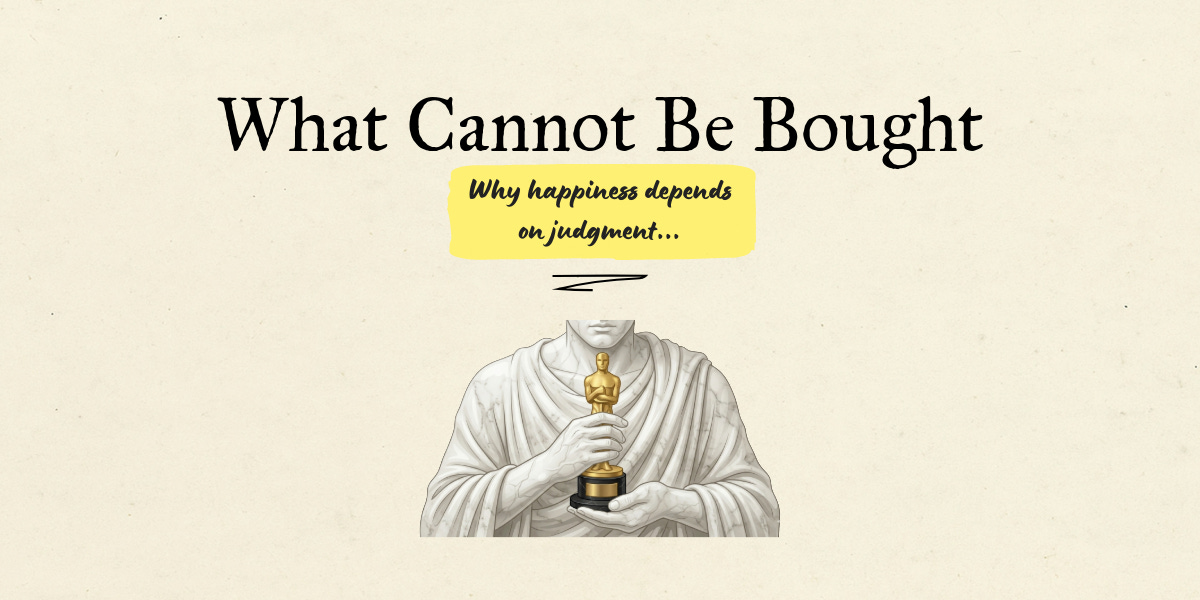
One of the appealing things about Stoicism is how often its lessons run refreshingly against modern mass messaging.
It can almost feel like a mental reset to consider the contrast between an ancient Stoic’s ideas about happiness and the ideas we’re encouraged to accept today.
One such idea is the Stoic assertion that wealth, possessions, and luxury fail to truly satisfy us, and can even make us unhappy if our attitude toward them lacks detachment.
This, of course, contradicts the implicit modern mantra of “more things, more happiness” that seems to pervade society.
Plutarch illustrates the error in this line of thinking in his work On Love of Wealth:
When some persons praised a tall fellow with a long reach as having the makings of a fine boxer, the trainer Hippomachus remarked: “Yes, if the crown were hung up and to be got by reaching.”
So too we can say to those who are dazzled by fine estates, great houses, and large sums of money and regard them as the greatest of blessings: “Yes, if happiness were for sale and to be got by purchase.”
The Stoics lived according to the same principle: you may be able to buy many things, but your mental well-being will never be one of them.
If it were otherwise, then every rich person would necessarily be happy and content. But as Seneca pointed out, the poor are no more unhappy—and no more anxious—than the rich.
And as the Stoic philosopher wrote in his 17th letter to Lucilius, it’s our thoughts, not our possessions, that determine our happiness:
For the fault is not in one’s wealth but in the mind itself. That which had made poverty a burden to us has made riches a burden as well.
It matters little whether you lay a sick man on a bed of wood or a bed of gold; wherever he be moved, he will carry his disease with him.
So, too, it matters not whether a diseased mind is set down in wealth or in poverty. The malady follows the man.
This Stoic emphasis on detachment from external goods doesn’t apply only to wealth. It extends to status, fame, and recognition as well. A vivid example of this appeared in a very different arena centuries later: modern Hollywood.
In 1970, the actor George C. Scott played George S. Patton in the film Patton.
He researched extensively for the role—studying archival footage of the U.S. World War II general and speaking to those who knew him—and delivered a performance that received widespread acclaim.
His portrayal was good enough to win him the Best Actor award at the 1971 Oscars. But Scott shocked Hollywood by becoming the first person ever to refuse an Academy Award.
In a telegram sent before his win was confirmed, Scott politely asked not to be considered:
I respectfully request that you withdraw my name from the list of nominees. My request is in no way intended to denigrate my colleagues.
Furthermore, peculiar as it may seem, I mean no offense to the Academy. I simply do not wish to be involved.
Elsewhere, however, Scott was far more direct:
The whole thing is a goddamn meat parade. I don’t want any part of it.
It’s quite a Stoic stance when you think about it—the kind of detachment from praise that allows one to focus on doing one’s best and being content with that alone.
Because to place a high value on external awards is to set oneself up for disappointment that could otherwise be avoided.
In this way, Scott embodies the same lesson Plutarch and Seneca were teaching in their own time—applied not to money, but to admiration.
It also raises some interesting questions:
Who decides the Oscars are important?
Does the winner truly deserve the award more than the other nominees, or even those who weren’t nominated?
And if George C. Scott didn’t need an Oscar, does anyone?
In his book The Practicing Stoic, Ward Farnsworth describes the Stoic resistance to conformity, to the opinions of the majority, and to the habit of looking outward when deciding what to value and how to act.
He offers a clear summary of the Stoic attitude toward praise:
The Stoics regard the appetite for praise as one of the mainsprings of conformity in particular and human behavior in general. They set out to tame it. They start by asking why we care what others say and think about us, especially when the others are people we probably do not hold in notably high esteem.
The Stoic develops a distrust for popular judgments, and a suspicion of people and things that have mass appeal. Stoicism tries instead to substitute a greater respect for one’s own opinions, and practice at valuing things for what they are rather than for what anyone else thinks about them.
George C. Scott certainly seemed to possess that distrust of popular judgment and that suspicion of mass approval.
It’s one thing to understand this idea in theory. It’s another to practice it, especially in a world that constantly pulls us toward comparison, recognition, and external validation.
Perhaps we can follow Scott’s example today, and begin to build a greater respect for our own opinions.
(If you’d like help turning ideas like this into a daily practice, I share short Micro Morning Meditations each weekday.)
