



There‘s a lot of advice about mornings.
Wake at five (or 3:30 if you’re the actor Mark Wahlberg). Drink water with a mysterious green powder mixed into it. Journal for exactly seventeen minutes. Exercise like a maniacal Greek deity. Avoid your phone. Visualise success. Become a new (somewhat unhinged) person before breakfast.
All of which may be useful to somebody.
But Stoicism doesn’t require a heroic morning. A daily philosophical awakening isn’t as dramatic as it sounds.
It doesn’t need a perfect routine, special equipment, or even the kind of discipline that makes ordinary humans feel ashamed to start their day.
You don’t need to read the complete works of Seneca before breakfast.
This will be a nice relief to anyone who has breakfast plans, employment, children, a dog, a body, or a normal human attention span.
A morning Stoic practice can be much simpler than that. In fact, it may work better when it is simple.
A few quiet minutes. One useful thought. A small intention for the day ahead.
That’s enough to start.
Because a morning practice sounds lovely until morning actually arrives.
Some mornings begin peacefully. Others begin with the mind rushing ahead to a future catastrophe that hasn’t happened, may never happen, and would probably be less impressive than the version currently being produced in the private theatre of the still-sleepy head.
This is where coffee can help.
But only up to a point.
Stoicism offers another kind of help: the chance to pause, notice what the mind is doing, and choose a sensible path before the day gets properly underway.
Did you know that Marcus Aurelius had mornings too?
This is worth remembering, because it is easy to imagine ancient philosophers existing only in marble, robes, and translated wisdom.
But Marcus had to wake up. He had to face duties, people, interruptions, irritations, bodily discomfort, and probably the deeply annoying paperwork that came with ruling an empire.
His morning self pep-talk is quoted often:
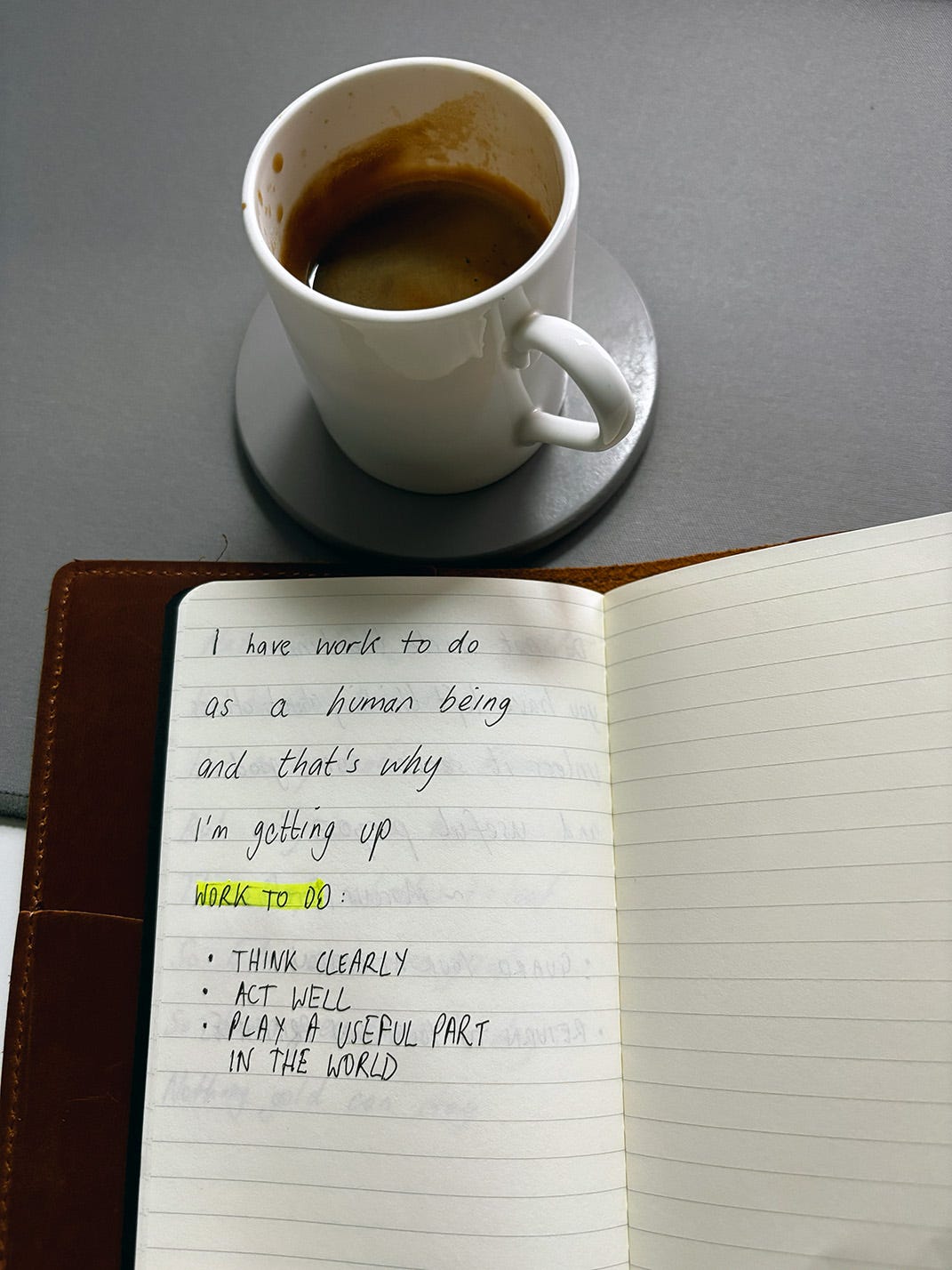
At dawn, when you’re reluctant to get up, have this thought readily available: I have work to do as a human being, and that’s why I’m getting up… Or is this what I was made for, to lie in bed and keep myself warm?
…Can’t you see plants, sparrows, ants, spiders, and bees all doing their own work and playing their part in the world’s order? And are you then reluctant to do human work? Why aren’t you eager to do what comes naturally to you?
That’s why a Stoic morning practice can be so useful. It gives us a chance, before the day gathers speed, to remember what kind of person we would like to be as it progresses. To remind ourselves what we were made for, the part we have to play.
What a Stoic morning practice is for
We know we can’t magic up amazing days. No practice or potent hydration potion can guarantee that.
The day may still be difficult. People may still be unreasonable. Plans may still change. Your mind may still wander off and start composing arguments for conversations that will never happen.
We’re not trying to control all of that. We’re preparing ourselves for it. The best time to prepare for something is, of course, before it happens.
A simple morning practice gives you a chance to remember a few things before the world wakes up. Three good ones are:
What is actually within your control
What kind of person you want to be today
Where the day is likely to test you
That’s enough. That’s manageable.
Not because it makes you invincible, but because it gives your attention somewhere useful to return when the morning calm, if there was any, has floated gently away to be replaced by the kind of chaos that characterizes most earthly days.
A simple morning practice
Here’s a little progression to gently prime the mind before the day really begins.
1. Pause before input
Messages and headlines and inboxes and good old spoken words are coming soon. Before all those attention seekers, take some time to yourself.
Give your mind a few moments to get its bearings.
Grab a coffee or a water (powdered health-boosting additions optional) and have a seat. Confirm you’re alive and attentive by taking a few conscious breaths. Pet your pet. Notice your immediate surroundings. Already, you’ve begun your day on your own terms, rather than someone else’s.
2. Choose one thought to carry
Don’t try to carry the whole Stoic tradition into the day. It can get heavy.
One useful thought is enough. Seneca said it himself: After you have run over many thoughts, select one to be thoroughly digested that day.
It might be a line from a philosopher. It might be a reminder that your judgment is yours to govern, even when events aren’t. Maybe it’s a question: What kind of person do I want to be today?
The mind isn’t a philosophical bucket that needs filling, said Plutarch, it’s more like wood that needs igniting.
3. Ask what’s in your control today
This is one of the simplest Stoic questions, and one of the easiest to forget the moment life becomes even slightly inconvenient.
What is actually up to me today?
Certainly not the weather. Definitely not the mood of other people.
Not whether every plan unfolds neatly. Not whether the train is on time, the meeting is useful, or your dog turns her nose up at the healthy new food you’ve presented to her.
But some things are yours.
Your judgments. Your choices. Your effort. Your tone. Your honesty. Your patience. Your willingness to pause before reacting.
This question isn’t meant to make you passive. It’s meant to save your energy for the places where it can actually do some good.
So before the day begins properly, ask:
What might I be tempted to control today that is not really mine to control?
And then:
What is mine to do well?
That small distinction can change the whole shape of a day.
4. Anticipate one likely test
The Stoics often reflected in advance on what might test them.
This doesn’t mean gloomily rehearsing disaster or expecting everything to go wrong. It means thinking about what realistic challenges lie ahead.
Maybe there’s a difficult conversation you need to have. Maybe you know you’ll be tired later. Maybe you can sense your boss piling tasks onto your already heavy workload.
Ask gently: Where am I likely to become reactive today? What would a wiser response look like?
5. Write one sentence of intention
Finally, write one sentence.
This isn’t a manifesto, autobiography, or a legally binding contract with the universe. Just one line you can focus on and recall as morning becomes afternoon becomes evening.
Some examples:
Today, I will pause before replying.
Today, I will not argue with what has already happened.
Today, I will remember that other people’s moods are not mine to manage.
A useful, practical sentence is better than an elegant one, especially before breakfast.
If five actions seems a lot, here’s another way to think about it…
The five-minute version
Also known as the “I can actually do this” version.
If you want to keep it very simple:
Minute 1: Sit, pause, and breathe
Minute 2: Choose one thought to carry
Minute 3: Ask what is in your control today
Minute 4: Anticipate one likely test
Minute 5: Write one sentence of intention
Five minutes to start the day well, that’s all.
If you’d like a simple place to begin
If this sounds useful, but you’d like a little structure, I’ve put together Your First 7 Days of Stoic Practice.
It’s a gentle, self-paced introduction—one small reflection at a time, without pressure, streaks, or the feeling that you need to become a marble bust by Thursday.
Start Your First 7 Days of Stoic Practice
One of the days includes a full Micro Morning Meditation, so you can try this kind of short morning practice for yourself.
Marcus Aurelius reminded himself that he had human work to do.
Most of us do too, though thankfully with fewer imperial responsibilities and, hopefully, less paperwork.
A morning practice helps us remember that work before the day scatters our attention elsewhere: to act with judgment, patience, courage, fairness, and care.
Not perfectly, but in a way we can manage. A way that allows us to keep making progress.
That’s enough to begin. Good morning.

Somewhere Mark Wahlberg is up at 3:30 with his green powder, feeling quietly accused. Also noticed the seven days come without streaks, which is rarer than it should be, half the practice apps out there would have you back at day zero for missing a Tuesday.